AI Support for Next Design Adoption, Migration, and Extension
Next Design is a design tool that lets teams define metamodels and views to build a design environment tailored to their own processes. Making full use of that flexibility, however, requires specialized knowledge and work such as profile definition, digitization of existing design assets, and extension development.
The Next Design AI Toolkit combines DC Agentiqs AI agents, Next Design MCP, and dedicated Next Design Skills.It supports the practical challenges of adopting, migrating to, and extending Next Design through collaboration between AI and people.
AI creates initial models and code and presents validation results. People review and refine the output in Next Design, continuously evolving a design environment that fits the field while preserving existing assets.
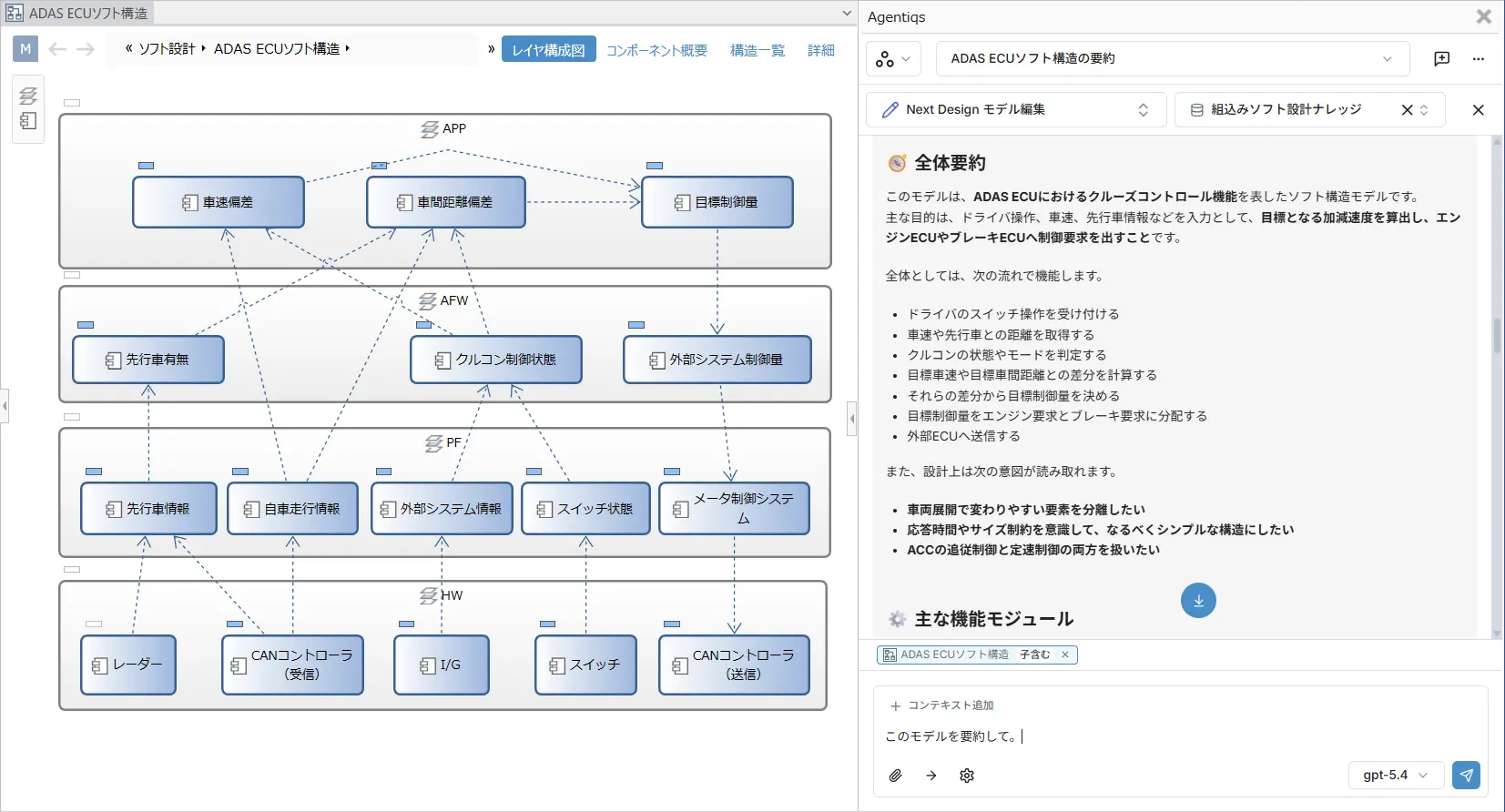
- Next Design is a design tool sold by DENSO CREATE
- Modeling design data accelerates AI adoption. For details, visit the Next Design product website.
Three Barriers to Effective Next Design Adoption
From initial adoption to sustained use in the field, Next Design presents challenges that cannot be solved by a single function. This capability addresses them across the full lifecycle: adoption, migration, stabilization, and ongoing evolution.
- Creating profiles that fit your design process is difficult
- Existing design assets in Word and Excel are difficult to migrate to Next Design
- Developing extensions for custom validation and tool integration is difficult
AI, Programs, and People Collaborate to Refine Design Deliverables
AI interprets documents and instructions to create initial models and code. Programs verify completeness and consistency against defined rules. People focus on design intent and business decisions, then finalize deliverables in Next Design. Combining these strengths makes creation, verification, and improvement more efficient while maintaining design quality.
Build Your Design Environment with Three Areas of Support
Build Profiles and Models
Discuss metamodels, classes, enumerations, inheritance, relationships, and view structures with AI, then create an initial version in Next Design. Teams can explore structural options and advance profile design before experts define every element manually.
Review and modify the generated model in Next Design. Additional instructions to AI can also rebuild selected parts.
Migrate Existing Design Assets
Load existing design documents managed in Word, Excel, or PDF into DC Agentiqs and instruct it through chat to convert them into Next Design models. AI interprets the document content, and the generated model summary can be reviewed in chat.
Export the mapping between source documents and models as a completeness-check report. People can identify problems or omissions and correct them directly as migration proceeds.
Develop Extensions
Provide AI with knowledge of the Next Design API, metamodel API, and extension project structure to support design, code generation, and modification for custom validation, import and export, external-tool integration, bulk design-data updates, and operation automation.
Support development from clarifying the desired capability through implementation for simple scripts, script-based extensions, and C# .NET DLL extensions.
Core Components Connecting AI and Next Design
This capability combines DC Agentiqs AI agents, workflows, and dedicated Skills with Next Design MCP, which connects Next Design through MCP. Next Design MCP provides the foundation for AI to reference, edit, validate, and operate the interface of a running Next Design project.
- Next Design MCP: Supports referencing, editing, and validating metamodels, models, traceability, diagrams, and more
- Existing Design Asset Import Skill: Supports document modeling, review, correction, and completeness checks
- Next Design Extension Development Skill: Uses API and project-structure knowledge to support design, code generation, and modification
Continuously Evolve a Field-Fit Design Environment Using Existing Assets
With the Next Design AI Toolkit, designers and software developers can reduce manual model creation and asset migration, then continue working after adoption by immediately reviewing AI-generated results in Next Design against their own processes.
Project managers and design leaders can reduce reliance on individual specialists for profile definition and migration, making rollout planning easier to manage.
Once design assets are organized in Next Design, teams can run a continuous improvement cycle with DC Agentiqs. AI agents and workflows continually reference and validate models, support reviews and completeness checks, and suggest corrections—improving design quality, reducing rework, shortening lead time, and contributing to better QCD.